Pages

Steady. Interesting, but steady.

Friday, July 30, 2010

On Wednesday morning I found the Yellow Legged Gull again so it is looking like it is doing what it normally does and should hang about for a month or so. Which is nice. It briefly showed yesterday lunchtime. That’s the steady bit. The only interest has come from Gulls. I had quite a long look over a flock yesterday lunchtime, and it was quite varied. Black-headed Gulls loafing, including a couple of juvs, there were a few juvenile Herrrings, some of which would be classed as first winter types as well as other summer or winter 'types'. There was also a big 2nd summer GBB, and nearly every variation of LBB on show including a cracking looking 3rd winter type – nice fresh feathers on all but the secondaries. Peachy. Did I say interesting? Well, if you don’t dig gulls it is was pretty boring I guess. Your loss.

While we are on the subject of books, I have two things that I just have to get off my chest. Firstly, The Big Gull Book (which really is brilliant) is a bit disappointing with some of the coverage of argenteus Herring Gulls – it’s really good for argentatus and all the rest but we don’t have them much over here. I just find it disappointing, and a little annoying that a book that is obviously going to sell very well in blighty is a bit light on one of the trickier ID’s and a bit 'Scando-centric'. So there.

Secondly, in that Big Year book about the mad twitchers rare bird enthusiasts, right, the author reckons that Al Levantin (one of the three protagonists) cannot smell. He was evidently an industrial chemist and after many years in the lab his nose packed up. This meant that when he went to a place called Brownsville Dump to look for Tamaulipas Crows (whatever they are) he had a distinct advantage over the other birders because he couldn’t smell the detritus that was attracting the crows. However, earlier in the book he was on a pelagic and could smell the cod liver oil and chum as it went over the side. Now, either he could smell or he couldn’t. Which one is it? How do you expect me to believe all the other tales in the book if you can't tell me if for sure if a mans nose works or not? Eh?  Answer that for me.

There, I feel better already.

Have a picture of some gulls.  On a beach.


Gulls on a beach doing spot the Med.  Yummy.

letting the days go by

Wednesday, July 28, 2010

After all of last week’s patch tick craziness, it is back to normal. The days roll on, the tide rises and falls, and the same birds fly about a bit when they can be bothered. 

Admittedly I did briefly see a Common Sandpiper again on Monday but that is by far and away the most interesting thing that has happened. There does seem to be a small increase in the amount of Woodpigeons flying through, and yesterday I heard a Robin sing – now that was a novelty. Due to recent reports of a Med Gull in the vicinity, every single gull in the patch has been getting a lot of attention. Normally optics need not be raised to eliminate the flying Black Headed from a Med search, but as most of them are moulting, most of the secondaries are all over the place at the moment so the wing profile is a bit wrong. So I have been birding furiously, but to no avail.


On Sunday I was watching Red Kites. This was very enjoyable. While I was in the area there was a Jackdaw with no tail. When in flight it looked like a small black owl. This also was enjoyable.


A gull doing an example of wing moult patterns in late summer with particular attention being paid to the secondaries to illustrate what I meant in the rambling text.

Kings of Leon and pigeon poo

Tuesday, July 27, 2010

You might have heard about this, you might not.  The story is told here.  I think it is quite funny.

how do i work this?

Monday, July 26, 2010

So the year list for the patch is now higher than last year by one. In fact I am now in the biggest year of my patch life for this patch. And it’s only July. I was in the 29th best patch in London last year, but even with last years total beaten, I'm only in the mid thirties.  And that's assuming that all the other worthy patch birders have updated their lists.  So to maintain the top 30 status pop-pickers I need a big year.

Funnily enough, I’ve just finished reading The Big Year by Mark Obmascik, which if you have any lists of birds that you see, you will enjoy. Three now legendary birders in America try to break the record for the most birds seen in America in a year. The winner (Sandy Komito) ended up with 745. If you haven’t read it (regardless of which side of the pond you sit on), get hold of it. It’s a ruddy good read. Their antics would make the most mental UK twitcher rare bird enthusiast look like a reasoned patch birder. Kind of.


The interweb also informs me that this subject is now being made into a comedy film with Jack Black, Angelica Houston and Steve Martin along with a load of actors that I’ve never heard of but are probably regarded as celebrities. I suspect that this will be rubbish. I digress. This is now the patch Big Year, I’ve already broken the record due to the recent run and the good fortune that the severe winter weather brought at the beginning of the year.  So what should I have, and what might I get, to move further into unknown territory?

Here are six species that I had last two years that have yet to appear this year.

Goldcrest – should be a cert in the Autumn/Winter
Collared Dove – rare but annual, only a matter of time
Brambling – a previous one off
Green Sandpiper – not wholly unlikely
Greenshank – a previous one off
Oystercatcher – a previous one off, but not uncommon in West London.

So out of that lot let’s say that I’ll get two more - 67 for sure.

Now, for the Brambling, let’s assume that there is a finch of somer sort knocking about for the year – either that or a Siskin, a Bullfinch or maybe even a Reed Bunting. 68

For the waders, let’s assume that one of the above will drop in at some point – 69

Which leaves me one off the heady heights of 70. So we need to spread the net a bit wider.

Ducks. I have never seen a Pochard on this patch, which is slightly odd. Other candidates in this area are Shelduck and/or Shoveler. So let’s call that a nice round 70.

Gulls. I’m never short of Gulls in the winter, so it’s only a matter of time before something from the top drawer pops in . Med is my best bet (there was one in Chiswick over the weekend - hubba hubba!). – 71

Accidentals. This is where I need to be really lucky. But the following are seen on occasion within a couple of miles, Warblers, Osprey, Hobby, Sand Martin, Snipe, Dunlin, Plovers, Godwits, etc etc etc

Extrapolate from that lot, and in the spirit of the Big Year, nothing less than 73 will be accepted.  The chances of getting it though is another matter...

A Swallow, doing into the blue again.

well, how did i get here?

Friday, July 23, 2010

I think that I may have been in the wrong patch this morning.  I got uncommon birds and a patch tick par excellence.

The tides have been high at lunchtime this week, so the only good birding is in the morning.  Obviously, this being this particular patch, good birding means that the birds that are not there at lunchtime are there in the morning.  Which is fine.  It's a patch, and that's what it is all about.  Or is it?

I got to the river this morning, spied a couple of Grebes close in and some gulls.  So far, so really very normal indeed.  Then a Common Sandpiper flew past calling, and it was close in.  That'll do me.  Waders on this patch are very hard to come by so I was more than happy to try and follow this shivery winged rarity for half an hour or so.  Except that as I turned in one direction, I heard a familiar call behind me.  If I was at Cley, I wouldn't think twice about it.  Well maybe to check if something rarer was with it, maybe with spots.  But in the context of the patch I knew this was special.  I was stopped in my tracks and the adrenalin started to flow.  It called again - tyu-yu-yu - "holy shit I've got a Redshank".  There have been reports of one in the same borough, but just up river so I was hoping against all hope that one might come past, but as I spun round and eyeballed the foreshore there were five.  FIVE!  "Holy shit - there's five Redshanks".  Five lovely little patch ticks all in a row.  I was staggered.  And still am.  Of course, they flew off.  Record shots below.

Bloody hell.  I'll go and look for this sandpiper then.  Two wader species in a day.  Remarkable.  I got further down river and didn't find a sandpiper, but did find a Yellow-legged Gull.  And there was a Common Tern, and a summer plumage Common Gull (niiiiice..).

What is going on?  It's like the birding equivalent of Once In A Lifetime...

You may find yourself birding in a half decent patch


You may find yourself in another part of the Thames


You may find yourself in a beautiful patch, with a beautiful tick


You may ask yourself: well... how did I get here?

loo list update

Wednesday, July 21, 2010

This morning I was incredibly not excited when I saw a female Mallard flying across the wide vista that can be seen from the loo window.  'Oh' I thought, 'that is a mallard' I continued internally.  'Hang on a minute', I continued again, and internally again, 'thats a bloody loo tick!'.  And so it was.  This brings the loo list to a staggering 32 species. 

The patch continues to do little.  Loafing Black-headed Gulls now regularly over 100.  5+ LBB.  The odd Tern.  Only a Wren sings.  I Redshank upriver refuses to show itself.  I can almost smell the imminent Med Gull.

'A Med Gull?' you say.  'What does that look like?' you continue.

Well if you insist...

A Med Gull doing what it looks like.

no pictures of flying ants

Tuesday, July 20, 2010

Yesterday was Flying Ant Day in Fulham.  That day in the year that flying ants come out and kamikaze style whack into everything, largely including my head. 

It is of course on flying ant day that people walk around going "it's flying ant day - look at all those ants".  All day.  And to everyone that they know.  As if we all know why it is that the ants take to the air, and that we care.  Or that we have some affinity with the ants, or even that we had been looking forward to flying ant day.  Although it has no cultural significance, it never gets on the news, everyone was talking about flying ants yesterday.  I suppose it beats going around saying "it is hot" all day which is equally inane.  Maybe it's the company I keep during the day.  Anyway,  I didn't take any photos of the ants, but instead I proffer some random buggage that I have come across recently.

Exhibit 1

Harpalus affinus

According to my book...

The elytra range from metallic green or blue, through bronzy red, to almost black with the outer areas punctate and slightly pubescent.
I have no idea what that means.

It is small and it looks like this.


Exhibit 2

Yellow Shell.  Camptogramma bilineata

It's a moth.


Exhibit 3.

Ringlet.  Aphantopus hyperantus.

It's a butterfly.


I have recently found a spider with a pink back but I cannot discuss this here as spiders, as I am sure you know dear reader, are not bugs.

I did see some birds yesterday.  But it wasn't very exciting.

they're back

Friday, July 16, 2010

Stop!  To ensure that the atmospherics of todays offering are correct, go back to the title of the post and put on your horror-movie-trailer-voiceover-voice on.  Go on.  The super deep gravelly voice that scares children but makes adults laugh because it is a bit stoopid really.  You know, the one that you can only do for a couple of words before it hurts your throat. And makes you cough.  But is occasionally worth it.  Now try again.

They're - baaack....

Excellent. 

Now see if you can read the next paragraph out loud (or if you must, internally) - but still with the horror-movie-trailer-voiceover-voice on.  If you don't follow the instructions, you will not get the most out of the post.  Now come on, play along!

In a world where everything was tidal, he was a humble patch birder.  He thought that they had gone, but this winter they have returned.  To haunt his dreams....  They are back, and this time they have abraded tertials.  He, armed with nothing more than a copy of the the old Collins and the Big Gull Book, must I-D them all.        Before.    They.    Send.    Him.     Insane.            From the maker of Death On the Wandle, and I Know What You Moulted Last Summer, coming to a patch near you - Thing stars in Dodgy Gulls Of Winter Part II - The Hunt For The Cachinnans....


A Common Gull doing first of the winter in a second summer progressing to second winter progression situation.

more kestrel food

Wednesday, July 14, 2010

As I mentioned, and you've probably forgotten already,  gull numbers rise.  Interestingly (in the context of not much being of interest) a couple of juvenile Black Headed Gulls are knocking about.  Their inconsistent wing pattern does occasionally give microseconds of excitement as nothing similar has been seen round here quite some time.  In other gull action, the GBB's were back on the barge, but are doing nothing more exciting than standing up, moving a bit, and sitting back down.

A juvenile gull doing floating.


There is more fresh Kestrel food in the patch too, with a lovely new batch of a half dozen Mallard ducklings knocking about by the houseboats and a single duckling in the Wandle delta.  Here is the obligatory rubbish picture of one of them on a handy bit of river detritus.

A duckling doing fattening itself up for a Kestrels lunch.

All of this incredible patch action paled into insignificance yesterday when it transpired that Mrs Thing has been awarded (and earned) a 1st Class degree.  To say that this is very good news is really understating the fact by a country mile.  Good on you kiddo.

patch tick!

Tuesday, July 13, 2010

That's right kids - another first for the patch.  Hot on the heels of the two year ticks (when it was decreed that this patch is now on fire) my next sojourn brought an excellent first for the patch!

Behoooooold!


Yes, I can see that it isn't a bird.  In fact my identification skills lead me to believe that this is, in fact, a butterfly.  I can also confirm that it is a Speckled Wood and I have not seen one of these in this here patch before.  And yes, it is not where it should be as it should be (as it's name suggests) in a wood, being speckled.  Not on a sandy bit of almost waste ground next to a big river.

Yes, I would have preferred to witter on about birds.  But if the highlight of a visit is 'oh, there are now more than 30 Black Headed Gulls knocking about' then the butterfly gets the nod.

another day, another year tick

Thursday, July 08, 2010

Oh yes. 

This patch is now officially on fire.  Common Sandpiper swiftly followed by a returning Yellow Legged Gull.  Why do I say returning?  Becuase likes to sit on this bouy.  Just like it did before.

64 for the year. And climbing. 

Yesterday there was a Red Kite over the Wetland Centre.  I think it's my turn now.  That or something else year ticky or patch ticky.  Anyone seen a funny looking Lapwing?

A Gull doing returning.

A Gull doing taking off.

year tick!

Wednesday, July 07, 2010

And about time too.  This one is pretty straightforward. 

I went to the river yesterday.  When I was there I saw a Common Sandpiper fly across the river and land on the foreshore.  It then flew back across the river (all shivery winged and that) and I didn’t see it again. 

And that’s how it happens.  Year tick. 63 for the year.

This picture shows you the area that the Sandpiper was in.  Just imagine that the gull in the picture is a small wader.  And that it is bobbing about.  And that will be approximately what I saw.


A Gull doing imaginary bobbing.

another series of random observations...

Tuesday, July 06, 2010

...and another moth free post.

There have not been many blog posts here lately, because not much is happening.   Unless you call grebes flying 'a happening'.  I've looked, but I haven't found much.  Not much happening, not much blogging.  That's how it works, innit.

A Yellow-legged Gull was recently seen on the patch, not by me either - see here.  Usually, if they stay for a little while, they stay for a long while.  If you get me.

There is a Chaffinch by my house that cheeps for most of the evening, almost constantly.  It is getting annoying.

I don't know anyone who wants Uruguay to win tonight.

That oil leak in the Gulf of Mexico is still leaking.

Home made scotch eggs are quite lovely.

There is a programme on the telly on Thursday about Harpy Eagles.  It is an hour long.  Yummy.

The moths from the other day were a European Corn-borer and Dark Arches.  One is a pest, and the other looks nothing like the picture in my book.


Birdlife now have a blog going on called the Birdlife Community.  It's ace.  Get on it.  It's not just conservation, or doom and gloom.  Just check out this Woodpecker.  And their tag cloud is immense.


Micro moths are not necessarily really small.


This picture is of a butterfly, not a moth.


A tatty White Admiral doing, phwoar look at that underwing!

I lied about this being a moth free post.

do me a favour

Friday, July 02, 2010

Someone please tell me what these bloody moths are!  I've been through my book at least 10 times trying to find something that is fits and have come close, but not close enough.  They are doing my bonce in.  Twisting my melons in fact.


Moth 1.  Not quite a Broken Barred Carpet, or is it.


Moth 2 - I can't even remember what I thought this was.


Yes, the quality isn't great, but no moths were harmed or chilled in the making of this blogpost.


anything about?

Wednesday, June 30, 2010

Basically, no.

At 5pm in the evening, it would seem that no birds have been seen in London today ...


the dream is over

Tuesday, June 29, 2010

Yes dear reader, the dream is over. I checked site yesterday and there are no young, just two adults. One of them aimlessly feeding, one of them standing on the nest and looking down through its legs, clucking away and expecting the little bald pates to appear from underneath it. They don’t, and won’t.


Now, one could anthropomorphise this whole situation, and if you did you would be sad because the Coots put in the effort to produce the eggs and one didn’t hatch, one nearly did, three did hatch but one chick didn’t last long. The two that were left were getting nicely plump just before they were eaten. If however, you don’t anthropomorphise the situation you will be glad to know that there is a Kestrel chick nearby with a nice fat stomach, full of Coot. Yummy.


With the loss of this nest, the birding interest on the patch is well and truly grinding to a summery halt.

Moths then.
Damselflies for sure.
Bugs if necessary.


Gulls anyone?


A Gull doing suddenly very interesting again.

sick as a parrot

Monday, June 28, 2010

Patch news, but not from me...

On the Wiki...

Friday 25 June 2010
Wandsworth: Hobby hunting over Wandle Creek at 5.30

Comment on this here blog from Michael Mac...

26 Jun (2 days ago)
I was looking at this nest today and saw no young only the pair of adults - there was another coot nest much futher down the river - so I take it the young have been predated?

A bloody Hobby!  FFS!  It won't come back, as there are no hirundines or dragonflies to eat.  I am as gutted as Frank Lampard.  Truly, truly pissed off.  A Hobby in the patch, and I missed it.  Gutted.

And as for the Coots, that really is bad news.  I'll be back, but what I'll have to show only the patch will tell...


A Whitethroat doing nervy

a post regarding farting noises

Friday, June 25, 2010

Nothing to do with the wonderfully flatulent Johnny Fartpants I assure you, but it is to do with another kind of seemingly audible flatus. 

Farting hirundines. The evocative and once widespread summer sound of a flying wet fart. Or more accurately the lack of hirundines round here and therefore the lack of wet farting noises. Or even more accurately the lack of a particular type of wet farting noise, as there are other birds that make wettish (damp?) farting noises that are similar to the wet farting noises that I wanted to hear, but hadn't heard, that on occasion sounded exactly like the wet farting noises I did want to hear. It got to such a point that the wet farting noises I was hearing were being dismissed as farting imposters without being considered properly.  I refer to the wet farting noises I was hearing in the sky of course and not necessarily anything that was generated by your esteemed host's trouser department.  Absolutely not, no. 

However,  I remain convinced that I didn’t rule out any wet farting noises without good reason (a birders farting jizz if you like), and until yesterday all wet farting noises were definitely the wrong farts. That's right, yesterday I heard wet farting noises in the sky and eventually, after much potty-mouthed mutterings, found the wet farting culprits and finally got the wet farting noise creators on the year list.


62 – House Martin x 3

Phew.


And the Coots? No problems, they even have a drinking straw each.


Coots doing paaarp.

bored?

Thursday, June 24, 2010

It's late June.  There isn't much doing.  If you are sitting in front of a computer wondering what to do, preparing another blog post on moths just because you can't find any birds but don't really want to, here is some reading material for you.  Or if you are just looking for some web based work avoidance it will work just fine.

I and the bird 128

And just look at this bonkers bird!


There is more of that here...

fledged grey wagtails

Wednesday, June 23, 2010

Grey Wagtails have fledged for (at least) the second year in a row. Last year they fledged at the end of May, the two that I found yesterday were fresh out of the nest and there may be another to come. Nearly a months difference on the fledging time, so this time round I suspect that the first nest failed – and they didn’t nest in the same site as last year.


Here is one that has found a home on a mattress that was once in a Caravan.


Here is the other in a bush.


A Grey Wagtail doing fluff.


A Grey Wagtail doing don’t worry about the Coots they are fine.

i knew before

Tuesday, June 22, 2010

I still haven’t found the Grey Wagtail nest. There is one, of that I am sure. There is a female and a male Grey Wagtail, the male sings a lot and the female wasn’t seen for a while. Yesterday I saw both of them, in the same area at the same time and both had gobfulls of insects. One after another they flew to a similar place and then flew off. I think the nest may be underneath a bridge. But I thought that last year, and was very wrong. Elsewhere there was a couple of Common Terns floating up the Thames and some recently fledged Carrion Crows. Noisy Goldfinches, a flock of Long Tailed Tits. Greenfinches drinking from puddles in the road. Tufties floating. That kind of thing.


But you don’t care about all that, do you? You’ve come here to see what happened to the Coots and their chicks. You have come here for your daily dose of schadenfreude at my expense as I tear my hair out at the futility and desperation caused by the vicissitudes of one family of small water birds. Well dear reader, take that look off your face. I can see through your smile, you would love to be right and I’ll bet you didn’t sleep well last night. So here you are, here is the update what exactly has happened since the last instalment?

Well, not much actually. The big nest is a bit smaller, the little nest is a bit bigger and the two chicks are a bit bigger too.

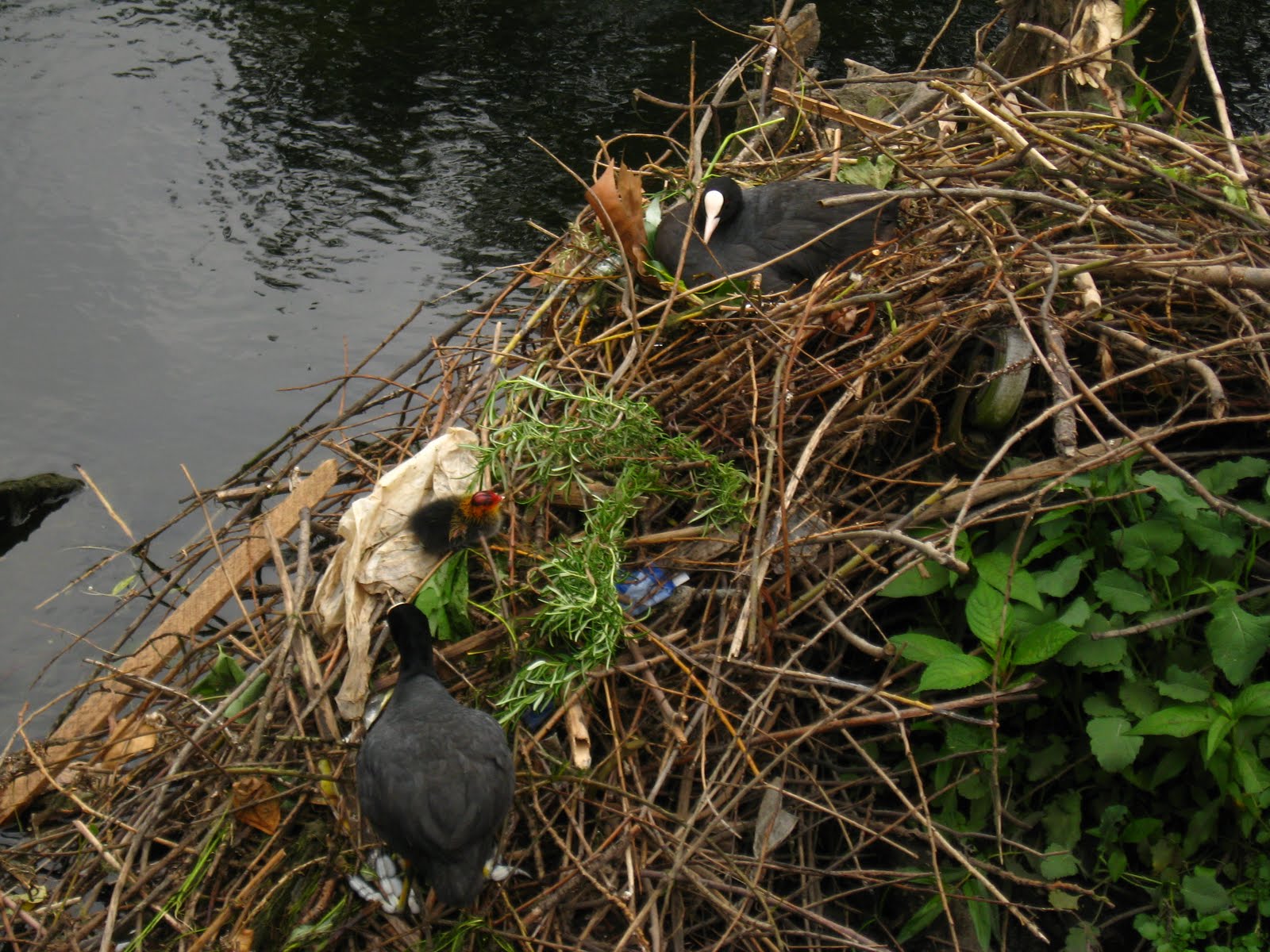
Here is a picture that shows the size of the two nests in question.


Still, if this nest progresses well and I’m a bit short of Coot based drama – worry not – look what I found a mere four hundred yards from the shopping trolley!


Yep, it’s a fresh nest in a tidal river that isn’t high enough! Hurrah!

and then there were two

Monday, June 21, 2010

Oh dear oh dear oh dear.  It's not meant to go like this, but then again perhaps it is.

This is how it is.  There are now two chicks, one has perished.  It is no more.  Predation?  I don't think so, the site is just too tricky to access.  The problem is this...


Yes, it is a nest with two chicks in it.  What's the matter with that you say dear reader?  Well it isn't the original nest, the nest that was high enough to hatch three and a half eggs. It's new, it's low, and it is rubbish.   

After the initial hatching was over, the adults moved the functioning cup of the nest a little further down the pile which I can understand as it meant that they could put fresh material in etc etc.  It then seemed that as the week went by they slipped further down the pile and closer to the water.  This wasn't a problem while the top of the nest was still above the high tide mark, but now it isn't.  Each time they have a new site the adults build, and when they build they take any material they can get their shiny little beaks on and the best source of nesting material is a nest that is not being used.  Henceforth the top of the best nest is falling and there is no easy point for them to the chicks out of the water when high tide arrives.  As Coots are not one of those waterbirds renowned for carrying chicks on their back the young may not be able to get out of the water at high tide, get a chill and drift off down the Wandle in their terminal torpor. 

To exacerbate this scenario, they have now started building a completely new nest (as per the picture) and this is being built a few yards down from the original nest.  When I last watched them the adults were extremely busy taking from the good nest and building up the new.  To such an extent that the original (once good) nest will now be totally covered during high tide as will the new nest leaving the chicks nowhere to go when the tide rises.  The adults, while being quite industrious have rather screwed the whole thing up. 

I suspect that when I next visit, there will be less than two chicks and quite possibly less than that.

the england algeria pigeon

Saturday, June 19, 2010

The best bit about the match last night (apart from the result of course), was a spot of birding from the sofa....

Speckled Pigeon?  Answers on a postcard...


A pigeon doing “Nice to see your home fans booing you. That’s loyal supporters.” Snigger.

today i will mostly be eating..

Friday, June 18, 2010

...crab.

And feeding it to four day old chicks for good measure.  For those that thought that Coots just eat weeds, this may come as a pleasant surprise.  I'm assuming that it is a Mitten Crab as they are not unknown in these parts, but one of the Coots did bring a crab to the nest yesterday.  The legs and the insides went down quite easily.  The chicks were not too keen on the shell though.


There was, for a short while, a Grey Wagtail on the nest site too.  Which is always nice.  Coots on the left, wag on the right.


Where the Coots are sitting is actually not the original nest itself, they seem now to have a couple of spots on the pile where they like to spend their time, just a short but perhaps significant distance from the rotting carcass of their sibling.

Have another Wagtail picture.


A Grey Wagtail doing nice.

a missed opportunity by springwatch...

Thursday, June 17, 2010

...and Coots too.

While flicking between the improving Uruguay and Springwatch last night, I caught the bird race feature.  Both teams ended up going to the Wetland Centre.  Perhaps a little contrived, but perhaps not a surprise.  The full details of the visit, I assume, will be in tonights programme which might be viewed depending on how bad France are (the worse they are, the less of Springwatch will be seen I reckon). 

I'm supposing that they didn't realise how close they were to the 29th best patch in London, and how close they were to the drama unfolding in the Wandle.  2.1 miles - that's all.  They could have had a wander around the patch and seen very little, and very easily too.  A missed opportunity for sure.

Day three

The chick in the egg didn't make it and it is now flattened at the bottom of the nest.  The fifth egg hasn't hatched.  The three chicks remain in situ. 

Coots doing day three.

day two

Wednesday, June 16, 2010

Everybody say.....bleeeeeuuuurgh


Baby Coots doing hit by the ugly stick - big time

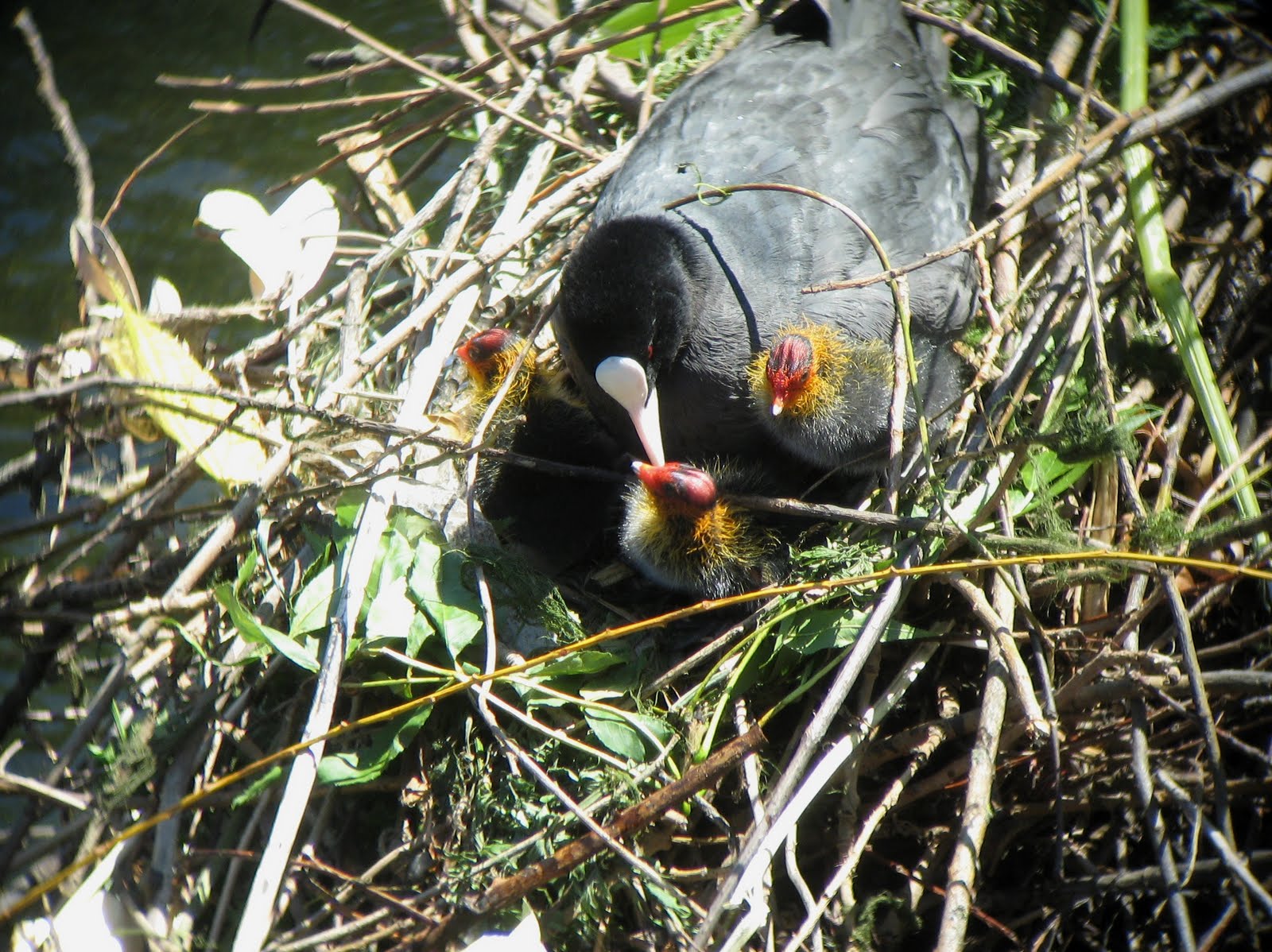
So there are the three chicks seen yesterday and the day before, there was another chick in the process of hatching while I was there which can be seen just below the adult in this astonishingly high quality image...


It was still moving and getting attention from the parent while I was there yesterday and one of the chicks even responded to it and pecked either its shell or beak too.  Perhaps there will be four then.  There is another egg in the nest, but it is probably a no-goer.  The adults didn't know what to do with themselves yesterday, three years of trying (instinctively) and then these little furballs turn up.  They were on the nest, off the nest, feeding the chicks, walking over each other, returning to the hatchling, and repeating again.  

Good stuff all round.  More updates on here regarding this nest are inevitable.  Stay tuned kids!

i'm not sure how to tell you this...

Tuesday, June 15, 2010

...but what do you reckon this is?


Why it's a day old Coot chick you say.  What's so special about that?

Perhaps if I put it in a little context for you...


Oh, you say.  That looks like a nest in the river Wandle that has been built on a shopping trolley by two Coots, and by golly it looks like there is a chick on the nest.

AT LAST! Insert a prodigious amount of joyful swearing right here................

That’s right dear reader, the Shopping Trolley Coots have, after at least three years of trying, incubated eggs successfully and now have young.  I say it again - the Shopping Trolley Coots have, after at least three years of trying, incubated eggs successfully and now have young

No, honestly.

No, I can hardly believe it myself either.

Lets have another view.


Yes, that is a Coot on a nest with a chick.  Gobsmacked I am.

Yesterday, there were three chicks and the adult was still looking after an egg or two. The weather was overcast and threatening to rain, so being young they stayed close to the female. 

I'll probably throw a cynical view in tomorrow, but for the moment just bask in the glory of persistence.

there's a dead moth in me kitchen

Monday, June 14, 2010

Beauty does not necessitate colour.  That's not another quote from one of those book things, it's an observation what I made.  Yes, Bee-eaters and Kingfishers are beautiful but some of my favourite birds are black.  Or white.  Or a combination of both, for monochrome simplicity is also beautiful.  And so it is with moths.

This moth (called an Ermine) was found in the kitchen over the weekend.  Dead, as you expected.


Very pretty moth (especially when it's alive).  Black and white doing it again.  Note the red patch on the back of it's head - it's not the norm.  I have seen this in Ermine before (get me!  Sounding like a right lepidopterist!) and this is how I reckon it happens.  They fly to the light bulb and bounce off.  And do it again, and again.  This slowly burns the fur (?) on the back of it's head of and then when it keeps going to the light it fries it's little brain up, and there it ends.  There was another one on the kitchen floor last week which also looked dead.  However, I picked it up and took it to the back garden where twenty seconds of direct sunlight brought it back to life and it flew off.

My moth list is now charging through the 20's with the addition of a few more species including this Light Emerald (Campaea margaritata), which can be assumed to be fresh as it is still quite greeny.


And no, over the weekend, I didn't see the Little Stint at Brent Res, nor the Common Rosefinch in Tottenham, but I might well see some Coots later today.

maybe, just maybe

Friday, June 11, 2010

If one wishes to give gravitas to a blog post, or a scientific treatise, it is always a good idea to supply a quote from some major thinker to show that you have researched the subject thoroughly. This shows that you have read the books, scribbled in the margins, stroked your chin and when you have come across the quote you have perhaps even said ‘hmmm’ under your breath and nodded sagely. Or perhaps you just found it in a book and thought that it looks clever. Either way, I will begin this posting about birds with an apposite quote.


'Birds in general are stupid'  Julian Huxley, 1923

Let me illustrate this point by discussing the nesting habits of three pairs of Coots. Specifically in the Wandle. I am going give three examples and use words and pictures to elucidate behaviour of said bird in some kind of pseudo-scientific way. You shouldn’t really be surprised by this if you are a regular visitor here. I don’t blame you if you go and find something more interesting to do. For those that wish to persist, here goes!

The three examples of nesting are categorised thus – 'the doomed', 'the doomed but interesting', and the 'once doomed but hopeful'. Stick with it kids, it’ll be over in no time.

The doomed.


Not so long back I showed the folly of a pair of coots that plonked down on the banks of the Thames as the tide exposed a suitable area. Here is another example in the Wandle. It is a different pair, of that I have no doubt (there are about five pairs round here, none of them with a hope in hell of success). This area of the Wandle delta is the closest to the chalk stream that wandle once was, and this area of the riverbed is exposed for no more than a few hours at a time, and the nest site and the collection of material is futile. Don’t mock them, they cannot help it.


The doomed but interesting.


Spotted yesterday on the Wandle. If you look carefully you can see that there is a Coot behind the reeds frantically pulling all the nesting material that it’s mate is bringing it into a rudimentary nest. It’s high tide, and the birds are nesting in a quite suitable area. Now, if this nest were being made by any other waterbird you could reasonably expect success. However, these are Coots. Do you know what the problem is? In an hours time the water level will fall, and the nest will become more distant from the surface of the water. And Coots don’t like this one little bit. It doesn’t bother Moorhens, but Coots have to have the base of their nest touching water. So, it was an interesting proposition, but I doubt if the birds will build a nest from the top down that will be 5 metres tall.  I've seen this pair (or birds holding this section of the river as territory) starting nests on freshly exposed mud at low tide, so it is possible that they are trying to build two nests a day.  Mad.


The once doomed but hopeful.


The perennial favourites.  The shopping trolley Coots.  Now this doesn't look much different to the last picture of this nest.  Or does it?  To recap, the Coots build a nest, the high tide comes in and the nest is destroyed.   Repeat.  This is the first time I've seen this particular build at anything like high water, according to my sources the high tide in Chelsea was due at 12:16, build in a delay for Wandsworth and the Wandle and the highest of the tide would have been around about 12:40 and I was there at 13.20.  Essentially this picture shows the nest at high tide.  And all is calm, which I have never seen before with high water.  No drama.  The top of the nest is dry.  The bird on the nest is still.  So this nest that is potentially half way through the incubation time may be high enough to avoid the worst of the tidal flux. Perhaps it isn't doomed after all. 

They couldn't actually go and do it could they? 

Maybe, just maybe...

counting coots in essex

Thursday, June 10, 2010

And now on Radio 4, it’s Woman’s Hour – CLICK!


I had to take Mrs Thing to the University Of Essex and then wait for a number of hours before leaving the University Of Essex.

“What will you do for four hours?” said Mrs Thing. “Oh, don’t you worry about that...”.

For those that don’t know, The University Of Essex is one of those post-war out of town campuses, and is situated in the middle of Wivenhoe Park near Colchester. Which is a park like area on the outskirts of a large town that is next to the countryside. Terribly convenient for someone such as myself with a penchant for staring into trees with lots of time to kill. I could have done a bit of research to try and find out in advance what to expect and where to focus my energies, but that’s no fun and doesn’t leave much space for exploration which is of course half the fun of going to new places. So with the radio turned off, the doors closed and locked I headed off to wander round the campus. And it was totally pissing down with rain. And it rained really hard, and then started to rain harder. After an hour this began to annoy me as all I had seen was some very wet waterbirds doing very little. Having to stand underneath trees to try and get some shelter while smoking wet fags was quite wearing so I decided that I was going to brave the full ravages of the weather anyway so set off again, and then the rain stopped and the sun came out. Which was very nice.


A lake type thing doing ornamental and wet.


It transpires that I had been round the more ornamental side of the campus, where the alien tree species are in full flow along with a fair few Rhododendrons chucked in for good measure (there is a private house there too which I assume is the university top dude’s residence). It was not filling me with hope for the following hours. However, once I had left this area I found myself in an area of open parkland with long grass and some big oaks dotted about, very similar to this picture in fact.

A picture doing rain on the lens.


This gradually gave way to a more open area at the top of a hill with less of the big trees – and this where the interesting birds started to appear (singing Goldcrest, Swallow, two Woodpecker species, Blackcap etc) so in all I was enjoying it a bit more. I found this sign and I really don’t understand what it is about.  I mean, it's a sign on a signpost but it doesn't tell you anything.  It's at the end of a path which ends at a closed gate and a wall.  It's by a road, which has cars on it, not cows.  It's very strange, and the more I think about it the more confused I get.  So I won't think about it any more.


I don't get it.  I really don't get it.


After drying off a bit, I headed downhill to see what was on offer there. More grassland, more Swallows, half a dozen Swifts and an overflying Shelduck. I then spotted (towards the train line) what looked like reeds. Not only did they look like reeds, but when I got there they were reeds. Not only that but there was a few Reed Warblers knocking about too! In this area in this photo!


Enjoying this area took up some more time, and beside it there looked like there was a big chunk of decidiuous woodland, so I ambled over there. Thankfully some nice people had put a nice path right through the middle of it. So I walked down the path, with some more Blackcaps singing, a couple of Chiffchaffs giving it some, Chaffinches, Tits, etc. Eventually it gave way to a couple of fields of rapeseed, where I heard a distant Skylark and a coughing Pheasant. The path looked very much like this...


Nice, huh?

Once I had walked up it, I walked back down it.  And that was about it. Best part of four hours walking round a new site and very good it was too. Plenty of habitat, a good spot for raptor watching (had the weather been better) and plenty of interest for a patch birder. 38 species in all for me but I suspect that there are more to get normally (no House Martin, Nuthatch, Treecreeper, House Sparrow, Willow Warbler etc).

A nice little patch on the whole.

Did I mention that there were Coots? You must have expected this...


Essex Coots doing wet.

Related Posts with Thumbnails