another day, another year tick
Thursday, July 08, 2010
Wednesday, July 07, 2010
Tuesday, July 06, 2010
...and another moth free post.
There have not been many blog posts here lately, because not much is happening. Unless you call grebes flying 'a happening'. I've looked, but I haven't found much. Not much happening, not much blogging. That's how it works, innit.
A Yellow-legged Gull was recently seen on the patch, not by me either - see here. Usually, if they stay for a little while, they stay for a long while. If you get me.
There is a Chaffinch by my house that cheeps for most of the evening, almost constantly. It is getting annoying.
I don't know anyone who wants Uruguay to win tonight.
That oil leak in the Gulf of Mexico is still leaking.
Home made scotch eggs are quite lovely.
There is a programme on the telly on Thursday about Harpy Eagles. It is an hour long. Yummy.
The moths from the other day were a European Corn-borer and Dark Arches. One is a pest, and the other looks nothing like the picture in my book.
Birdlife now have a blog going on called the Birdlife Community. It's ace. Get on it. It's not just conservation, or doom and gloom. Just check out this Woodpecker. And their tag cloud is immense.
Micro moths are not necessarily really small.
This picture is of a butterfly, not a moth.
Friday, July 02, 2010
Someone please tell me what these bloody moths are! I've been through my book at least 10 times trying to find something that is fits and have come close, but not close enough. They are doing my bonce in. Twisting my melons in fact.
Wednesday, June 30, 2010
Basically, no.
At 5pm in the evening, it would seem that no birds have been seen in London today ...
Tuesday, June 29, 2010
Monday, June 28, 2010
Friday, June 25, 2010
Nothing to do with the wonderfully flatulent Johnny Fartpants I assure you, but it is to do with another kind of seemingly audible flatus.
Farting hirundines. The evocative and once widespread summer sound of a flying wet fart. Or more accurately the lack of hirundines round here and therefore the lack of wet farting noises. Or even more accurately the lack of a particular type of wet farting noise, as there are other birds that make wettish (damp?) farting noises that are similar to the wet farting noises that I wanted to hear, but hadn't heard, that on occasion sounded exactly like the wet farting noises I did want to hear. It got to such a point that the wet farting noises I was hearing were being dismissed as farting imposters without being considered properly. I refer to the wet farting noises I was hearing in the sky of course and not necessarily anything that was generated by your esteemed host's trouser department. Absolutely not, no.
However, I remain convinced that I didn’t rule out any wet farting noises without good reason (a birders farting jizz if you like), and until yesterday all wet farting noises were definitely the wrong farts. That's right, yesterday I heard wet farting noises in the sky and eventually, after much potty-mouthed mutterings, found the wet farting culprits and finally got the wet farting noise creators on the year list.
62 – House Martin x 3
Phew.
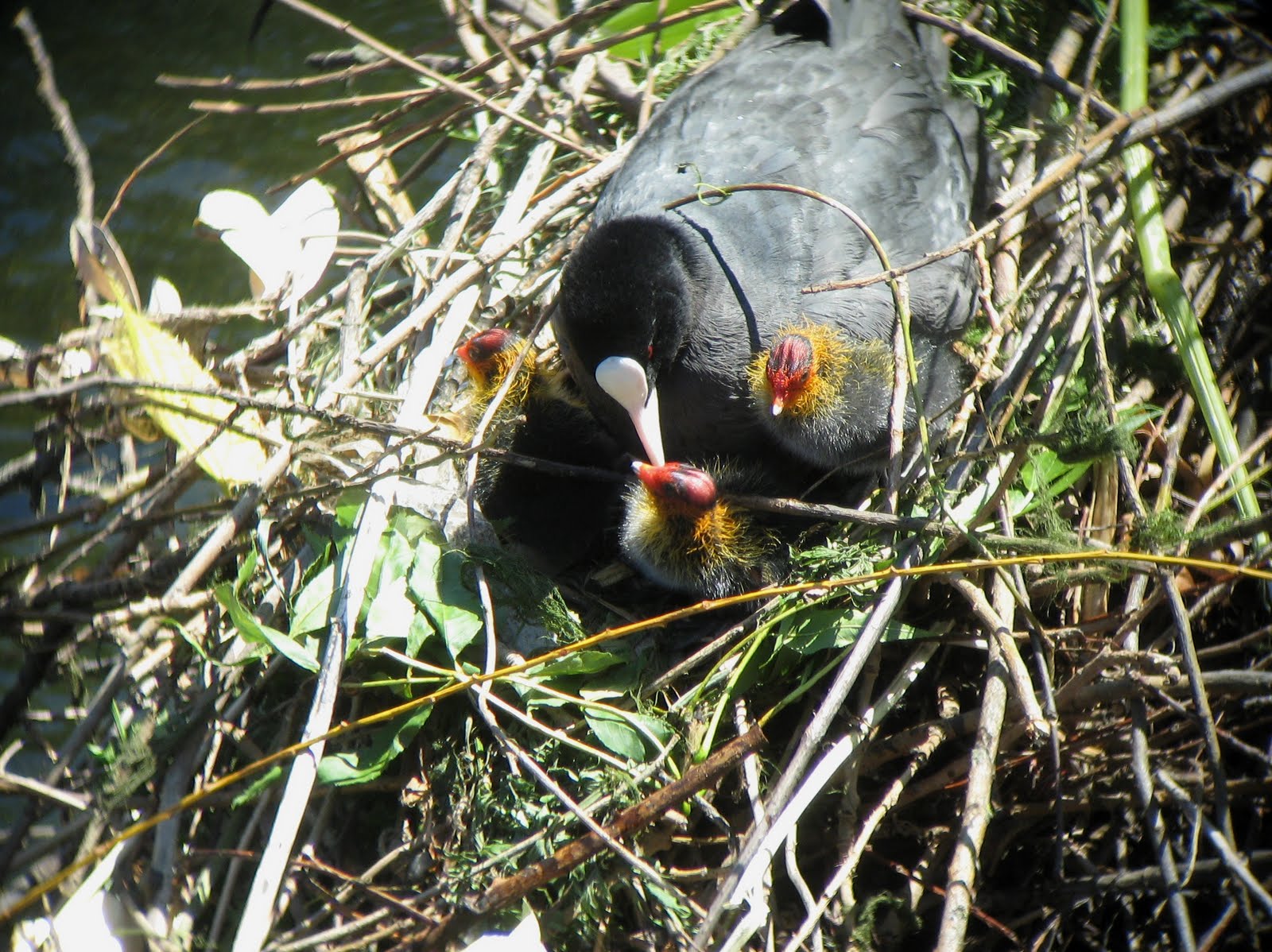
And the Coots? No problems, they even have a drinking straw each.
Thursday, June 24, 2010
Wednesday, June 23, 2010
Grey Wagtails have fledged for (at least) the second year in a row. Last year they fledged at the end of May, the two that I found yesterday were fresh out of the nest and there may be another to come. Nearly a months difference on the fledging time, so this time round I suspect that the first nest failed – and they didn’t nest in the same site as last year.
Here is one that has found a home on a mattress that was once in a Caravan.
Tuesday, June 22, 2010
I still haven’t found the Grey Wagtail nest. There is one, of that I am sure. There is a female and a male Grey Wagtail, the male sings a lot and the female wasn’t seen for a while. Yesterday I saw both of them, in the same area at the same time and both had gobfulls of insects. One after another they flew to a similar place and then flew off. I think the nest may be underneath a bridge. But I thought that last year, and was very wrong. Elsewhere there was a couple of Common Terns floating up the Thames and some recently fledged Carrion Crows. Noisy Goldfinches, a flock of Long Tailed Tits. Greenfinches drinking from puddles in the road. Tufties floating. That kind of thing.
But you don’t care about all that, do you? You’ve come here to see what happened to the Coots and their chicks. You have come here for your daily dose of schadenfreude at my expense as I tear my hair out at the futility and desperation caused by the vicissitudes of one family of small water birds. Well dear reader, take that look off your face. I can see through your smile, you would love to be right and I’ll bet you didn’t sleep well last night. So here you are, here is the update what exactly has happened since the last instalment?
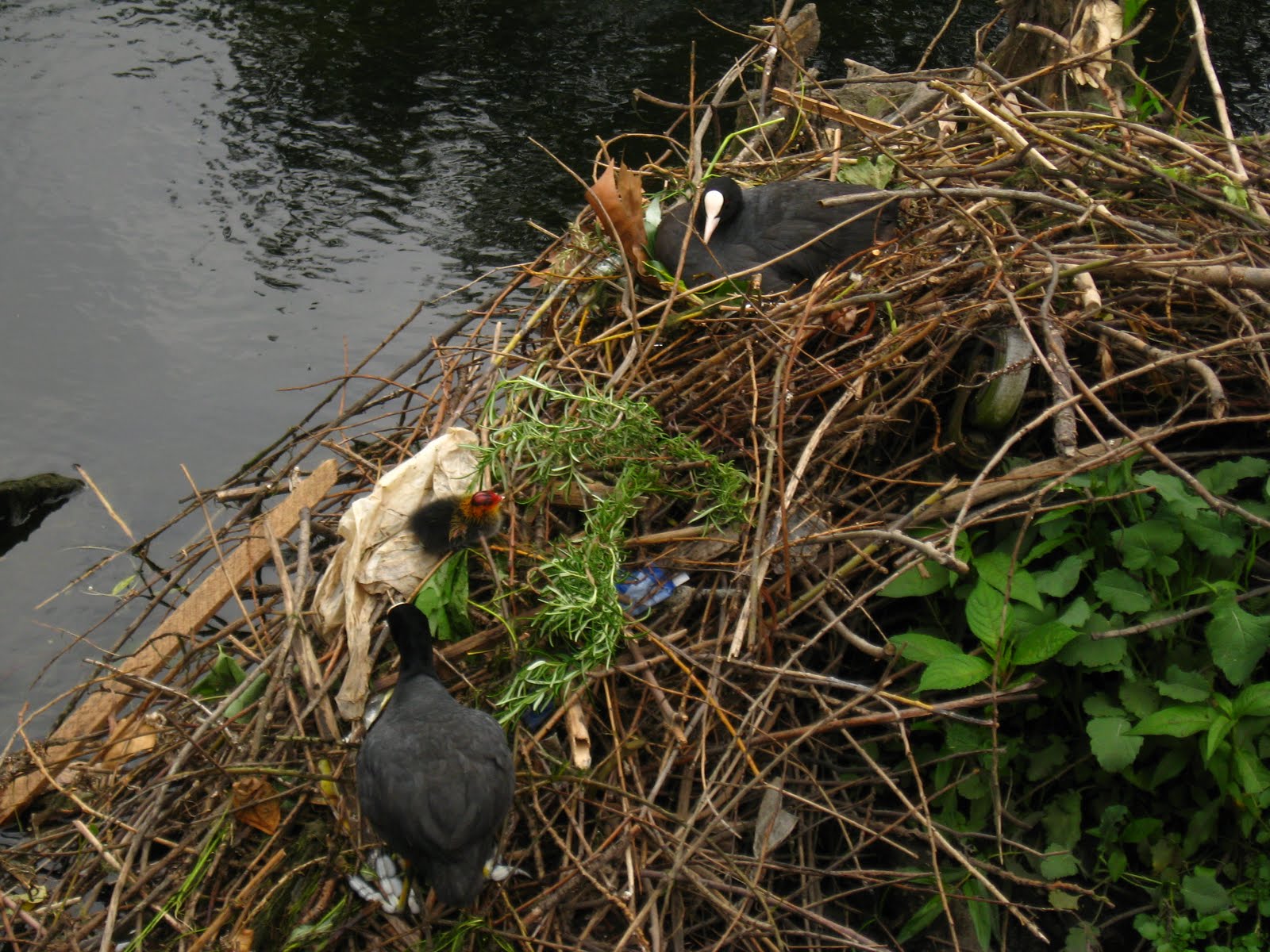
Well, not much actually. The big nest is a bit smaller, the little nest is a bit bigger and the two chicks are a bit bigger too.
Here is a picture that shows the size of the two nests in question.
Monday, June 21, 2010
Saturday, June 19, 2010
Friday, June 18, 2010
Thursday, June 17, 2010
...and Coots too.
While flicking between the improving Uruguay and Springwatch last night, I caught the bird race feature. Both teams ended up going to the Wetland Centre. Perhaps a little contrived, but perhaps not a surprise. The full details of the visit, I assume, will be in tonights programme which might be viewed depending on how bad France are (the worse they are, the less of Springwatch will be seen I reckon).
I'm supposing that they didn't realise how close they were to the 29th best patch in London, and how close they were to the drama unfolding in the Wandle. 2.1 miles - that's all. They could have had a wander around the patch and seen very little, and very easily too. A missed opportunity for sure.
Day three
The chick in the egg didn't make it and it is now flattened at the bottom of the nest. The fifth egg hasn't hatched. The three chicks remain in situ.
Wednesday, June 16, 2010
Tuesday, June 15, 2010
...but what do you reckon this is?
Monday, June 14, 2010
Friday, June 11, 2010
Thursday, June 10, 2010
And now on Radio 4, it’s Woman’s Hour – CLICK!
I had to take Mrs Thing to the University Of Essex and then wait for a number of hours before leaving the University Of Essex.
“What will you do for four hours?” said Mrs Thing. “Oh, don’t you worry about that...”.
For those that don’t know, The University Of Essex is one of those post-war out of town campuses, and is situated in the middle of Wivenhoe Park near Colchester. Which is a park like area on the outskirts of a large town that is next to the countryside. Terribly convenient for someone such as myself with a penchant for staring into trees with lots of time to kill. I could have done a bit of research to try and find out in advance what to expect and where to focus my energies, but that’s no fun and doesn’t leave much space for exploration which is of course half the fun of going to new places. So with the radio turned off, the doors closed and locked I headed off to wander round the campus. And it was totally pissing down with rain. And it rained really hard, and then started to rain harder. After an hour this began to annoy me as all I had seen was some very wet waterbirds doing very little. Having to stand underneath trees to try and get some shelter while smoking wet fags was quite wearing so I decided that I was going to brave the full ravages of the weather anyway so set off again, and then the rain stopped and the sun came out. Which was very nice.
Wednesday, June 09, 2010
Monday, June 07, 2010
Friday, June 04, 2010
Wednesday, June 02, 2010
A popular wildlife programme is currently having a certain focus on Avocets at the nest. If the bird is not jusdadooorable, then I’m sure that it will be soon – as most birds on that programme are (although good on the male presenter for seeing the potential chick as a Kestrel meal).
I have seen these birds in the wild, and on more than one occasion in fact. I saw some this year and I saw some last year. And the year before that. Etc. However, when I see them these days – despite their innate and undeniable beauty, the grace, the ridiculous yet practical beak, the incongruous leg colouring and even the wonderful name, I just don’t get excited by them. I call it ‘Avocet fatigue’, and I’m sure that I’m not the only birder out there that feels that way. Maybe not about Avocets perhaps, but I’m guessing that some birders really cannot get excited about birds they see all the time, regardless of their beauty/significance/rarity/charm etc etc.
I know why I suffer from Avocet fatigue, it’s because in the eighties I spent a month on an Island in Suffolk where there are a lot of them. And then I went back the next year for a fortnight. I don’t know how many there are these days but I have checked the BoEE counts that I have in my slapdash notebooks and there were 234. And there were that many every bloody day.
So do excuse me if I don’t pay too much notice to them on the telly but perk up a bit when the raptors are killing stuff. Like the Hobby. The one catching dragonflies that is, not the one sitting on a mans arm eating chicken.
Springwatch. You gotta love it.
Sunday, May 30, 2010
Friday, May 28, 2010
Thursday, May 27, 2010
Yesterday, I received an e-mail from Birdlife, which was nice. So I read it, and it turns out that it wasn't.
For those that haven't recieved it or don't know what it's about, here it is, verbatim.
Dear Bird Blogger,Although many of us will not have heard of the Alaotra Grebe, it's extinction is symbolic not just because it is a bird. Because it is a bird, it produces headline news and is treated with more significance but in the time that it has taken for this bird species to have been eradicated there have been hundreds if not thousands of other lifeforms that are gone. Extinct. For ever. Extinction is a bit like pregnancy, you cannot be a bit pregnant, nor can you be a bit extinct. For the Alaotra Grebe, that's it. And we did it. Shame on you.
Today we announced that Alaotra Grebe is officially extinct on the Red List.
The Dodo is the undoubted ‘celebrity’ among extinct species with its depiction in books, cartoons and the well-used expression ‘Dead as a Dodo’. Less well known about the Dodo is that it heads up a group of single island flightless birds that became extinct either at the hands of man, or by the introduction of predators that came along with the arrival of people to their islands. More than 130 species of birds have become extinct since AD 1500, mostly because of human actions...
When BirdLife publicises news of threat or extinction the first question posed by the media will be: “Why should we care?”
We're asking you to tell us why species matter. Do you care?
Please encourage your website visitors to leave comments on this page:http://www.birdlife.org/community/2010/05/alaotra-grebe-extinction-do-you-care/
To read the full story, click here: http://www.birdlife.org/news/news/2010/05/red-list-for-birds-2010.html
Thank you for your support.
Nick Askew
Wednesday, May 26, 2010
I'm still a bit old fashioned when it comes to identification. I want to look in a book to find out what something is. This means that I have lots of books about identification of birds (not that it means that I get it right of course) and when it comes to moths and butterflies the same applies. The two moths that I proffered yesterday were not in my book, so I had to go to my percieved second option and ask someone else. I could have done what Jonathon claims to have done and go to the UK Moths website and look through the pictures of all the species until I found the right one, and then wouldn't have bothered y'all with my little request. The thing is that it never actually occured to me! Not for one minute did I think that there may have been a valuable resource online that could help. Not in a book, see. So for those that are still interested...
Image 1 was a Bee Moth Aphomia sociella and it is common. Bee Moths are sexually dimorphic, and this was a female. They are, of course, common.
Image 2 was a Light Brown Apple Moth Epiphyas postvittana. UK Moths says the following about it...
This originally Australian species was probably accidentally introduced into Cornwall in the 1930's and since then has spread quickly northwards, and is now regular in many parts, and very common in some areas [of course - Ed.].So there.
A pest species in Australian orchards, it is one of the most catholic polyphages in Britain, and should be considered as a possibility when identifying larvae off any plant.
It flies in two generations between May and October.
Tuesday, May 25, 2010
Free CSS Templates | Converted into Blogger Templates by Theme Craft | Falcon Hive